
Renate / breathing 'slow'


How I met my best friend Breath😊,
In this post, where I share how I met my friend Breath, you’ll read how to use your breath to stay calm in extremely stressful situations. You’ll also find information about the Acceptance and Commitment Therapy (ACT), a method that helps increase resilience—very useful in stressful times and in life in general. At the end (after the pictures), you’ll find a simple breathing experiment you can try yourself to check how healthy your breathing is (in a normal situation).
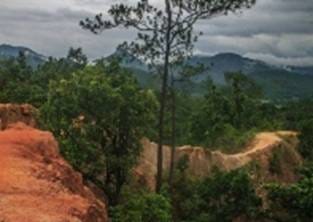
How did I meet Breath? To explain that, I’ll take you back to the summer of 2017. I had just finished my volunteer work in Chiang Mai (Thailand), and decided to stay a few days in Pai before my flight back home to the Netherlands. It was a beautiful Monday afternoon, just before sunset, and I was hiking in Pai Canyon together with Jeff and Sal (whom I mentioned in my previous post). Pai Canyon is a very beautiful canyon with amazing views, but also deep ravines and narrow paths. And sometimes there are rocks you need to climb over to reach a path (as you can see on the photo of me and my backpack). Sal was afraid of heights and waited halfway until Jeff and I would return.
I was walking in front, enjoying the beautiful views, and Jeff walked behind me doing the same. Suddenly I heard a slipping sound—I thought Jeff had slipped. In that moment, I learned my biggest coaching lesson ever: always check first if there is an actual request for help before offering it .... I turned around, ready to help. But Jeff was standing upright, perfectly fine. However, as I turned, I slipped and fell flat on the narrow path. Then I felt myself sliding away—I didn’t know where or into what—and I tried to grab onto something. But the only things I could grab were the tiny stones lying on the path. I looked at Jeff and he looked at me, and I still can see the shock on his face as I continued sliding and then fell freely into the space below.
I had sometimes wondered what goes through people’s minds when they fall unintentionally in the mountains. I had never expected it could be something practical. I was falling, seeing the rocks rush past me, and I thought: “How deep will I fall?” I knew the ravine was 150 feet deep, and I realized that if I was falling into that ravine, it would be the end. A very practical thought. Nothing frightening or spiritual I had imagined you might think in a moment close to a possible death.
Right after the thought, I felt my feet hit the ground, and right after that I landed extremely hard on my butt. I heard and felt krrrrkkk. It is hard to describe the sound and sensation, but I felt and heard something crack very loudly in my back. At the same moment, I heard somebody scream and I wondered, “Is that me?”: a moment of dissociation, as I learned later.
It turned out I had fallen through a hole, about fifteen feet down, into a cave about 7 feet wide. There was a narrow opening leading outside, where (if you would climb up over a pile of stones) you could reach the path where I just walked on. Jeff can climb up and down anything (give that man a tree and he’ll climb up and down effortlessly), and he climbed down over the stones and found the narrow opening very quickly. He squeezed himself through it and managed to reach me. I told him that something was seriously wrong with my back. So, he quickly left, climbed back up, and searched for help.
A few moments later, I saw a woman’s head appear above the opening I had fallen through, looking down into the cave. She didn’t know that someone already was looking for help. She saw me lying there, panicked, looked behind her and screamed: “Help, help! Who knows first aid?!”
Humour is my favourite survival strategy, so I shouted up at her: “Hi, I do!!” I thought it was a pretty good joke and started laughing. But I can tell you one thing: if you ever break your back: avoid laughing (or coughing or sneezing). It hurts a lót.
It took a while before help arrived, and humour didn’t reduce the pain, so I needed another strategy. Back then, I didn’t know much about breath, but I did know that conscious breathing makes pain more bearable. So, I started to breathe consciously, which was a bit slower than my breathing at that moment, and I started counting my breaths. I knew that giving my mind a task, would reduce the chance of unhelpful thoughts. Somewhere around 385 I lost count, and I had to start again at zero. Extremely frustrating. But frustration didn’t reduce the pain, I noticed. I suddenly remembered something a coach had once told me back in my student days. She said: If you miss a day, don’t start again at zero, just continue counting the next day. So, I started counting again up from 385. That helped.
After a while, about 25 rescue workers and soldiers arrived. They were standing on the other side of the narrow cave opening and were only talking. They didn’t speak English—only Tai. Luckily, Jeff speaks fluent Tai plus a few Tai dialects, so he understood everything they were saying. I asked him why nothing was happening, because all I heard was talking. “Well,” he said, “they have absolutely no idea how to get you out of here.” By that time, I had counted over 1000 breaths, and I can tell you: what Jeff just told me is not what you want to hear at that point.
Then I started getting cramps in my left leg and right hip. Moving with a broken back was something I needed to avoid, so what now? That problem was quickly solved. Two men from the village, who had offered to help, came down into the cave to sit beside me. One pressed against my left leg, the other against my right hip, providing counterpressure. They didn’t speak English, I didn’t speak Tai, but that didn’t matter. I learned that eye contact and knowing/feeling you want to help each other in an extreme situation is enough.
It was hot, about 95F. Someone came into the cave and offered me some water. I refused, because I remembered from a first aid course that with physical trauma you should avoid drinking. The body needs to focus all its energy on the trauma for the best chance of survival. If I would drink something, part of my energy would go to other processes instead of my back. Surprisingly, I wasn’t thirsty at all. My system apparently knew exactly what to do.
After a while, my two helpers and I saw a few wasps flying around. There appeared to be a wasp nest in the cave. Thinking about it didn’t help, so I returned my focus to my breathing. A few weeks later, I told a cousin of mine about the wasp nest, and he told me that I had been lucky there were no snakes. Apparently, when the sun sets, some snakes come out of their holes. The sun had just set, so it was a good thing I didn’t know about the snakes back then🫣.
A bit later, finally a doctor arrived and thankfully he spoke some English. He asked if I could move my toes. I had already checked that, but I also knew it doesn’t guarantee anything when it comes to spinal cord injuries. From an occupational therapist friend, I know that some people with a spinal cord injury sometimes even walk into the hospital themselves. The doctor asked if I was in pain: “YES I am!”, I replied. Then he pulled out two cotton swabs. He asked me if I wanted to sniff them. I wondered if I should ask what exactly I was about to sniff, but honestly, I didn’t care at that moment. If it would take away the pain, fine, I would have sniffed anything. He was a doctor, so I assumed it would be okay. It smelled like ammonia—not the most pleasant scent—but I sniffed it with full enthusiasm. The pain became a bit less. You’re doing fine, he said, and walked away. Never came back.
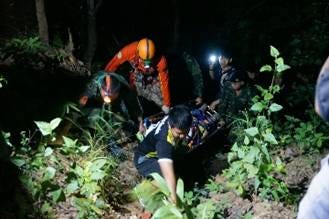
In the meantime, the rescue team had come up with a plan. They wanted to widen the narrow opening so that a stretcher could fit through sideways. And because the path back was no option (too narrow) they would climb down over the stones to the rainforest - carrying me on the stretcher - and create a path with pickaxes to a road where an ambulance was supposed to wait.
They used their pickaxes also to widen the opening of the cave. With that, small stones started falling down from above. “What if bigger stones come down?” I thought, “then it’s game over”. Those thoughts didn’t help, I noticed. I needed another strategy.
I continued counting my breaths and got the idea of going through the hexaflex of the Acceptance & Commitment Therapy (ACT). A method I often use with clients. It increases the psychological flexibility: you’ll experience less stress and anxiety, you’ll get a higher resilience, and you can deal more effectively with challenges in life. The situation I was in, was quite challenging, so doing an ACT session with myself seemed a good idea.
The ACT hexaflex has six core processes:
1) Acceptance
Or, as Gijs Jansen (psychologist, author of many ACT books and also my ACT trainer) put it: “Sit with your shit in a hole and embrace it.” Well, I was sitting/lying with ‘my shit’, in a hole, or a cave actually. I wasn’t fighting the pain, it was there, I accepted and embraced it. The breathing helped with that. Check ✔️
2) Defusion
Taking distance from your thoughts, seeing them as words instead of truth. I was already doing that by knowing that thoughts are only thoughts and changing strategies when unhelpful thoughts came. The breathing helped as well, so I kept doing that. Check✔️ By the way, defusion is my favorite part of the hexaflex, because I like humour😊 and there are many humorous interventions that create distance between yourself and your thoughts. However, I just experienced that humour—or more specifically the laughing that often comes with it—is not handy when you have a broken back.
3) Contact with the Present Moment/ Being in the Here & Now
I was completely in the present moment, breathing through the pain, breathing with the pain. That was the only way to bear it. Check✔️
4) The Self as Context
There is more about this, but in my case in that moment it was seeing myself from another perspective, checking & reflecting on what I was doing. Check✔️“This is going quite well”, I thought.
5) Values
What is important in your life? Well, I wanted to get out of that cave alive, I wanted to be able to see my children again, be able to walk again, morphine seemed like a fantastic idea too (the effect of the ammonia-stuff was gone by then), it would also be very nice if the rescue workers would hurry up a bit, and a shower sounded heavenly (I was covered in dust and gravel). But my biggest wish at that moment was to reach a hospital as soon as possible so I could get something against the pain. There was a moment when I asked myself whether this pain was worse than the pain I felt while giving birth to my children. Even though my first childbirth was very complicated and dangerous for me at the end, I decided that this back pain was definitely worse.
There is a model by Stephen Covey that I often use with clients: the “Circle of Influence.” It distinguishes between things you have direct control over and things you do not. I realised that everything I wished for lay outside my control. What I could control was: staying alert, staying calm, and holding on until I was in the hospital. So, that became my biggest value in that moment.
6) Committed Action
Taking concrete and conscious action in line with your values.
What did I need to do to stay alert, stay calm, and hold on? That was an easy question to answer: focus on my breath. That was the only thing that had helped me so far to stay alert and calm. And in that moment, in a Pai Canyon cave, I realized that Breath was, is and forever will be my best friend ❤️.
In workshops I use the hours in the cave to explain how I was able to lie there, relatively calmly, with a broken back. How did I influence the physical and mental stress in those moments? And how can you—in any stressful situation, big or small—calm yourself, create relaxation, and bring more peace to your body and mind?
A small piece of theory:
Everyone has a nervous system, our computer or command centre that sends messages throughout the body. One part regulates conscious functions like walking, cycling, driving, reading, eating, talking: things we do deliberately. Another part regulates unconscious processes such as heart rate, blood pressure, breathing, digestion, sweating: these processes just happen.
Most unconscious processes cannot be controlled. You can’t say: “Heart, slow down,” or “Blood pressure, lower yourself.” But there is ONE you can influence: your breathing. Normally, your breathing follows your state of being. When you run or feel rushed, breathing speeds up. When you’re startled, you hold your breath. When you feel relieved, you sigh. Your breath follows your state of being—how you feel at that moment.
But it also works the other way around: if you change your breathing, it automatically influences your heart rate, blood pressure, digestion, lungs quality, blood circulation, oxygen uptake in your cells and much more. It’s all connected with breath.
When you feel stress or tension, your breath is often faster than normal, higher up in the body, and your heart rate is then higher too. But if you start breathing more slowly, your heart rate starts to lower, your blood pressure lowers, your entire system calms down—and with it, your mind. Breathing differently has an effect on processes in your body and is an incredibly powerful tool for your health, especially in stressful moments.
And that is exactly what happened down in that cave. Because of my broken back, my heart rate, blood pressure, and breathing went up. By counting my breaths and breathing more slowly, my heart rate dropped, my blood pressure lowered, my mind cleared, and I was able to remain calm during the hours I was lying there in the cave. This also helped during the time the rescue workers made their way through the rainforest to the ambulance, and later during the drive to the hospital in Chiang Mai.
The fracture was too complex for the village hospital in Pai, so it took another three hours to get me to the hospital in Chiang Mai. Luckily, they gave me morphine, which reduced the pain. However, the morphine didn’t help when the ambulance hit a large hole in the road. It was night, and the driver didn’t see it. I think my screaming at that moment startled everyone who was out there that night. After that, I needed my breathing even more than in the cave.
Later it became clear that at that moment the “stable fracture” had turned into an “unstable fracture,” and I was only millimetres away from a complete spinal cord injury. Thankfully, the hospital in Chiang Mai asked a professor and surgeon—who has his own clinic and specializes in spinal injuries—to come to the city hospital to perform the surgery. He put a titanium construction in my back and managed to do that without me getting a complete spinal cord injury. I owe everything to that man 🙏🏻. He made it possible for me to still be able to walk.
In 2019 I had my final appointment in the hospital (in the Netherlands). It was a few months after I got a new titanium construction in my back, because there was a fracture in the old one (caused by metal fatigue). The doctor said: “This is it. Learn how to deal with it. There is a lot of physical trauma, and it isn’t going to get better than this.” At that time I was unable to walk for more than half an hour at a time or to sit for more than an hour and I regularly had to take pain medication.
In the previous post I wrote about ‘The body keeps the score’ and how Breathwork can be extremely helpful in releasing stored tension, also from physical trauma. It took a few years before I got the idea to add Breathwork to my coaching practice. How I got that idea? That is for another post. But I can tell you this: as soon as I started my breathwork training in 2021, a lot of stored tension in my back began to release, bit by bit. Thanks to Breathwork I can do só much more now than I could at the time of my final appointment with the doctor in 2019. I can now walk for an hour and a half at a time, I can sit for hours which makes it possible to travel again and I no longer need pain medication: one more reason why Breath has become my best friend.
That brings me to the end of this post and to the last part of a mantra Kasper van der Meulen - one of my breathing trainers- taught me: Nose, Slow, and Low. I already wrote about the benefits of nose breathing in the post about Cyndi. In the post about Grace and Jeff, you read about breathing low. And in this post you read about the benefits of breathing slow.
Try this: count your breaths for one minute. As you do so, try to breathe in the same rhythm you had before you started counting. One inhale and one exhale count as one breath. If you would like to do this now: stop reading before the pictures and count. Below the pictures of Pai Canyon and the rescue operation, you’ll find the effective number of breaths per minute.
For now: Merry Christmas🎄! In two weeks, there will be a new post: about a breathing session with James, who spent 21 years in prison, most of the time in Sing Sing Correctional Facility in New York. You’ll read what happens in your body during a connected breathing session and why it is very important to check contraindications before you decide to book a session for yourself.
In a ‘normal’ situation (not during exercise or right after meditation, for example), around 15 breaths per minute is common. But a more effective rate is around 6 to 8 breaths per minute. There are several reasons why this is more effective. A particularly important one is that you lose less CO₂ (carbon dioxide), which allows O₂ (oxygen) to reach your cells and organs more efficiently.
Dit is een mooi verhaal voor de podcast held in eigen verhaal….
Wow what a story! We hadden contact toen en je verhaal is mij altijd zo bijgebleven. Nu in detail te lezen, kippenvel! Bijzonder dat je op die manier moest ontmoeten wat nu je passie is en waarmee je anderen helpt. X