
Sandra / breathing beyond the thinking mind
Effects on physical, mental, emotional, and consciousness/spiritual level


In this post about a breathwork session with Sandra, you’ll read how connected breathing can help you move beyond your thinking mind and gain access to deeper layers of your system. Layers that are normally difficult or even impossible to reach. You’ll read about what you can expect on a physical, mental, emotional, and consciousness/spiritual level. After the photo you’ll find the ‘huff breathing technique’: a controlled way to help clear mucus from your lungs. Especially in winter, many people deal with mucus, which is why I chose this technique for the January post.
When I started my Breathwork Training in 2021, I told my favourite former colleagues that they were welcome to come for a free session. I needed practice hours, and I wanted to do that with people I like😉. Sandra definitely belongs to my collection of favourite former colleagues. We have known each other since 2003, when we both started working in a HR department of Achmea, a Dutch insurance company. We both left that department in 2014, but we have always stayed in touch.
The session in 2021 was Sandra’s first breathwork experience. We both will remember that session forever because it was so special: for her as a breather and for me as breathwork facilitator. A lot happened on all four levels: physical, mental, emotional, and consciousness/spiritual level. Thanks to connected breathing. How was this possible?
By breathing in a connected way, at a certain pace and depth, you move out of your head and into your body. From thinking to feeling. The thinking brain temporarily receives less oxygen. Is that dangerous? Not if it’s for a short period of time. In fact, it can be very pleasant: a moment of peace in your head😊. Your mind switches “off,” and you gain access to places you normally can’t—or hardly—reach: stuck emotions, memories, fears, pains, beliefs stored in your subconscious system etc.. All kinds of things can come to the surface, and by breathing through them you can (among other things) release stored tension, see things from a different perspective and experience an immense feeling of relaxation.
Sandra had no specific intention for the session; she was curious about what would happen. After a bodyscan, to start moving the attention from the mind to the body, we started the connected breathing part. She began to experience effects on the physical level, followed by the emotional level, after that the consciousness/spiritual level and at the end the mental level. People usually experience physical sensations at first, this was the case for Sandra. She felt tingling sensations throughout her entire body. Many people experience this; it’s a normal response caused by changes in the carbon dioxide/oxygen balance. It can sometimes also result in cramping or a stiff sensation. In Sandra’s case, her arms stiffened and besides that she felt discomfort in her shoulders. What did not happen with Sandra—but can happen—is feeling hot or cold, trembling, shaking, sweating etc.. It’s always a surprise how the body responds and what tension is ready to be released.
Before describing the effects on the other levels, some background information about Sandra, so you can put things into perspective. Sandra had been a caregiver for her grandmother for quite some time. In her Colombian culture, it is normal for a family member to be cared for within the family until death. Due to circumstances, this was not possible, and the decision was made to move her grandmother to a nursing home. Sandra visited her grandmother every day, alongside her job and caring for her daughter. Figuratively speaking, she carried a heavy burden on her shoulders—not only practically, but emotionally as well. Because her grandmother was developing dementia, Sandra had to say goodbye to the grandmother she knew, who had always been there for her and with whom she had shared a very strong bond.
After starting experiencing the physical effects, Sandra felt a lot of emotion. I could see that in the expression on her face and the tears she shed. Later she explained that these tears were tears of sadness: saying goodbye to the grandmother she knew—the woman who had raised her and whom she loved deeply. Her grandmother now had dementia, her personality had changed, and although Sandra still loved her dearly, she was no longer the grandmother she used to be. There was also a sense of guilt related to the move to the nursing home. For Sandra, the release of emotional tension manifested as sadness and tears. Depending on life experiences, also fear, or joy or other emotions can be felt. It can also differ from session to session, depending on your intention and what presents itself in your body.
Besides the physical and emotional effects, something also happened on a consciousness/ spiritual level: an expanded state of awareness emerged, within which communication was possible in a way she had never experienced in ordinary consciousness. She later told me that during the breathwork session she saw her grandmother as she was before the dementia. She had a conversation with her. The short version: her grandmother told her that everything was okay, that she didn’t need to worry about having placed her in a nursing home, that it was completely fine, and that she was proud of Sandra how she handled everything. This brought Sandra great reassurance, a feeling of relief and a deep sense of calm throughout her entire body. Letting go of her guilt also created relaxation, especially in her shoulders. In return, Sandra said goodbye with the words: “Thank you, it’s okay grandma, rest now. You may go. It’s all good.”
After that, Sandra got the insight on the mental level: that there is much more to perceive than we think we can perceive, and that contact on another level is apparently possible. With this insight more tears came, followed by more relaxation and softening in her system.
At the end of the session, the tears had dried, Sandra kept her eyes closed for a little while longer. Then she opened her eyes and told me about the conversation she had had with her grandmother. How much peace she felt and that the feeling of guilt had disappeared. The pain in her shoulder had also significantly decreased.
She said she was deeply impressed; it felt as if she had been on a journey. She found it very special and strange at the same time. Then she remained silent for a while. Suddenly, with her unique laugh (and anyone who knows Sandra knows exactly how her exuberant laugh sounds), she exclaimed: “Well, I’ve never used drugs, but it feels like I’ve just taken a pill!😄”. After that, she was quiet again for a moment; she tuned back into her feelings and indicated that she felt a great deal of gratitude.
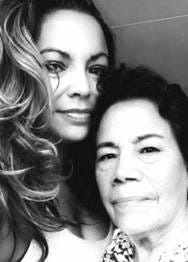
The photo below is from Sandra and her grandmother. I knew Sandra’s grandmother had passed away a few years ago, but I didn’t know when. When I sent Sandra the text of this post to check, because of the personal details, she replied the day after: “Oh dear, how beautifully written. Today is the day of the death of my grandmother, I am so happy with your text. I read it with tears, and also with a smile’. What a timing..
The huff breathing technique, or “huffing,” is a controlled way to move mucus from the small airway branches into the larger ones, where it can be more easily coughed. This technique saves energy and is great for people with chronic lung conditions. It protects the throat and vocal cords from irritation of hard coughing. It involves taking a breath and forcefully exhaling with an open mouth, like you’re steaming up a mirror. Huffing is not as forceful as a cough, but it can work better and is less tiring.
Preparation:
Part 1
o hand on your belly, relax the shoulders
o breathe in calmly through your nose to your belly
o breathe out calmly through your mouth
§ repeat this for four times
Part 2
o breathe in deep and slowly through your nose
o hold your breath for about three seconds
o breathe out calmly through your mouth, until your lungs are empty (in a natural way, so don’t push)
§ repeat this for four times
§ when your feel dizzy-> go back to part 1
Huffing:
o Sit up straight with your chin tilted slightly up and mouth open.
o Take a slow deep breath to fill lungs about three quarters full.
o Briefly exhale air through an open mouth and throat (as if you were trying to fog a mirror), you can hear mucus moving in your lungs (you hear it ‘bubbling’)
§ Repeat this for four times
The first photo shows Sandra during a breathwork session three months ago. It was a group breathwork session combined with a photoshoot, where we invited several regular breathers to participate in the presence of photographer Anke Olthof. Anke was present so quietly that no one noticed her at all, a true art. She is actually a grief photographer, and a former colleague of both Sandra and me. But a little detour from grief into breathwork sounded appealing to her😊, https://www.instagram.com/fotografie_anke_olthof/#