
James / contraindications breathwork


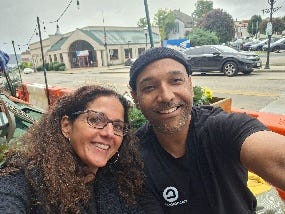
In this post, you’ll read about a breathing session with James, who spent 21 years in prison, most of that time in Sing Sing, a maximum-security correctional facility in New York (first photo). You’ll also read about what happens in your body during a connected breathing session, you’ll read about the contraindications and why it’s important to check these before deciding to book a session for yourself. At the end (after the photo), you’ll find an overview of the most important contraindications for connected breathwork.
James is a former participant in the Rehabilitation Through the Arts program (RTA), which uses, among other things, theatre, dance, and music to help incarcerated people develop skills for a successful return to society. There is a film about the RTA program, called “Sing Sing”. After watching that film, I had only one thought: Breathwork in Sing Sing.
I discovered that RTA works with volunteers, so I sent them an email offering to facilitate several breathwork sessions. Breathwork sessions turned out not to be possible due to security reasons. What was possible, however, was a general workshop: “how to use your breath to cope with stress”. Due to circumstances, these workshops had to be postponed. But I had already booked my flight, so I asked if there was a former RTA participant I could speak with, to get a picture of the life inside and of the specific moments people experience stress. And that’s how I met James. Some of you may have read about him in one of my LinkedIn posts: https://www.linkedin.com/in/renatedijkstra/
James lives in Ossining, the place where Sing Sing is located and also where I rented an Airbnb. During our first meeting, we talked for several hours. He provided me with valuable information about the life inside prison that I can use in the workshops and he became interested in breathwork. And the end of that first meeting, I offered him a breathwork session, but he didn’t respond. So, there was no ‘yes’. Which I could understand. Trust is an important ingredient in a breathwork session, and we had only just met. However, James didn’t say ‘no’ either, so I remained hopeful😉.
During the following days we spent a lot of time talking and walking. He was a perfect host and introduced me to a lot of people. “This city needs breath” he said, and I think I met half the city in 4 days😆. Including a few police instructors with whom I did a breathing exercise with. Some of you may have read about that on LinkedIn. On the last day of my stay, I told him: “If you would like to experience a breathwork session, then today is the last day we can do one”. After a moment of silence, he said: “okay.. yes, let’s do that”.
First we went through the list of contraindications. Safety always comes first. For a healthy person, connected breathwork is fine. But if you have certain conditions, doing a breathwork session can be unwise or even risky. Why? Because quite a lot happens in the body during connected breathing.
I have written before about removing the pause between the inhale and the exhale. By doing so, you connect the inhale directly to the exhale: connected breathing. In addition, you breathe deeper and faster. This changes the balance of oxygen and carbon dioxide in the body. In essence the faster breathing disrupts the system. This creates a stress response in the body, which, among other things, increases heart rate and blood pressure. You can imagine that a connected breathwork session is therefore not handy for people with heart conditions or high blood pressure. The stress response also triggers other reactions in the body that can worsen existing conditions. That’s why it’s so important to take contraindications seriously.
Below the photo, you’ll find a list of the most important contraindications for connected breathing. Not everything on the list is a strict no-go, but if something applies to you, it’s essential to discuss this with your breathwork facilitator.
When I went through the contraindications with James, he answered “no” to every question, until the last one: “Is there severe PTSD or trauma?” He remained silent. Then he raised one eyebrow, smiled, and looked at me. We both had to laugh about this question regarding his 21 years in prison. With three years in Rikers Island and eighteen years in Sing Sing he probably saw and experienced a lot…
I asked him about his intention for the session. Breathing with an intention can be helpful; it can serve as a compass for the subconscious, guiding the process toward what you wish to receive. James wanted to relax. Relaxation—okay, I thought. But with his background, it was likely that things related to trauma would come to the surface. We are going to take this very slowly, I thought. With everything in mind about what I’ve learned about breath and trauma, particularly from my first breathwork teacher Stephen Monné, I started the session.
From another breathwork teacher, Kasper van der Meulen, I learned to work with five “breath gears,” where gear 4 and 5 involve intense forms of breathing. With James, I gradually built up to gear 3 and stayed there. Even in gear 3, profound and beautiful processes can occur. You sometimes hear people say that only very long and very intense breathing sessions lead to the release of tension or to deep relaxation—but that’s simply not true. It is also possible with a slower connected breathing pattern and a shorter length of a session. Gentle, mild, and slow breathwork can be deeply healing.
In sessions with clients, I usually let the active connected breathing phase last between 30 and 45 minutes, depending on what the body tells/ shows what it needs. Followed by an integration/relaxation phase of 15 to 25 minutes, during which clients return to their natural breathing rhythm. Given James’ background, a maximum of 20 minutes of active breathing seemed sufficient to me, or shorter if his body indicated that less was better. And I decided to extend the integration/relaxation phase.
You can probably imagine that being in prison is stressful. You’re always on guard, constantly scanning your surroundings, never fully safe, never truly relaxed. The sympathetic part of the nervous system is active all the time. The nervous system consists of two main parts: the sympathetic and the parasympathetic part. You can think of them as the gas pedal and the brake. The sympathetic part activates the body for fight-or-flight responses, while the parasympathetic part helps the body rest and digest. It’s important that these two systems are in balance. Otherwise, it becomes too stressful. Ongoing stress affects (among other things) your muscle tension. That was the case with James. During the active breathing phase, where I also work with touch, I could feel a lot of muscle tension in his body. Through massage, movement, tuning forks, and the vibration and sound of the drum, some parts softened a bit.
When the integration/relaxation phase began, a big smile appeared on his face — and it stayed there the whole time (about 40 minutes). Later, he told me that during that phase, he experienced an immense sense of relaxation throughout his entire body and mind.
After the session, we said nothing for a while. Often, there are no words—and that’s completely fine. Describing a breathwork session in words is almost impossible. It is an experience, and even if words are found, they rarely do it justice. At some point, he looked at me and said: “Everybody should get the chance to experience this. This is so helpful. You should do this with everybody who just got out of prison.” And that became one of my plans for 2026😊.
In two weeks, there will be a post about a breathing session with Sandra. You’ll read how connected breathing can help you go beyond your thinking mind and access deeper layers of your system: layers you normally can’t easily reach. Besides that, you’ll read about what you can expect on a mental, emotional, physical, and sometimes even spiritual level.
GENERAL CONTRAINDICATIONS FOR BREATHWORK
Pregnancy (any stage), active use of recreational drugs, use of medication that alters brain chemistry (e.g. anti-anxiety, antidepressants, ADD, OCD medications), detached retina, glaucoma, kidney disease, high blood pressure, cardiovascular disease (including angina, prior heart attack or stroke), diagnosed aneurysm of any kind, uncontrolled thyroid conditions, diabetes (any type), severe asthma, epilepsy, history of seizures, tinnitus, prior diagnosis of bipolar disorder, schizophrenia (or other psychiatric conditions), severe psychosomatic disorders, recent surgery/ stitches/ injury, psychiatric hospitalization or emotional crisis within the past 10 years, and severe PTSD or trauma.
Like I said before: not everything on the list is a strict no-go, but if something applies to you, it’s absolutely essential to discuss this with your breathwork facilitator.
👍🏽👍🏽👍🏽😘